Choosing the best Plywood Laminated Board in 2026 depends on where it will be used, how it will be finished, and what conditions it must withstand. A smooth cabinet door has different needs from a workshop bench or a panel exposed to occasional moisture. Look beyond the product label. Check the face veneer, core construction, thickness, bonding information, and the manufacturer’s stated use. A clean edge can reveal uneven layers; a sample cut can reveal more than a glossy product photo.
This guide compares common board types through those practical details. It also considers surface quality, machining, stability, and value, while noting that performance varies by manufacturer and grade. There is no single best panel for every project. Even a well-made board can disappoint when its intended use is misunderstood. We would normally include a named industry expert’s verified quotation here, but no source material or interview was supplied. Inventing a person or quote would undermine the reliability this comparison aims to provide. Before choosing, compare current technical sheets and inspect a physical sample whenever possible. A few minutes with the panel may save hours of rework.
Which Plywood Laminated Board Is Best in 2026?
“Best” starts with where the board will live. EN 636 divides plywood into three service classes: Class 1 for dry interiors, Class 2 for humid conditions or protected outdoor use, and Class 3 for exposed exterior conditions. A kitchen cabinet usually needs a different class from a garden shed wall. Check likely moisture, not just the room’s label. A laundry area can stay damp. Class 3 does not mean every panel suits every structural load; confirm the product’s declared performance and relevant bonding standard, such as EN 314-2. Measure twice.
Scale matters, but it cannot replace specification. FAOSTAT’s Forestry Production and Trade database reports global plywood production at roughly 180 million cubic metres in 2022, showing how widely the material is used. That figure says nothing about a specific panel’s durability. For a sheltered façade, Class 2 may be appropriate only when the design keeps rain off and allows drying. For repeated wetting, specify Class 3 and protect cut edges, joints, and fixings. I would still inspect the site details: a technically suitable board can fail early when water collects along an unsealed edge. Cite: EN 636; FAOSTAT, Forestry Production and Trade database.
Define the application using EN 636’s three plywood service classes
How to choose: EN 636-1 is for dry conditions, EN 636-2 for humid conditions, and EN 636-3 for exterior conditions. Select the class that matches the board’s intended service environment; the class number is a designation, not a quality ranking.
Which Plywood Laminated Board Is Best in 2026?
Compare Veneer-Core Construction, Face Grades, and Structural Ratings
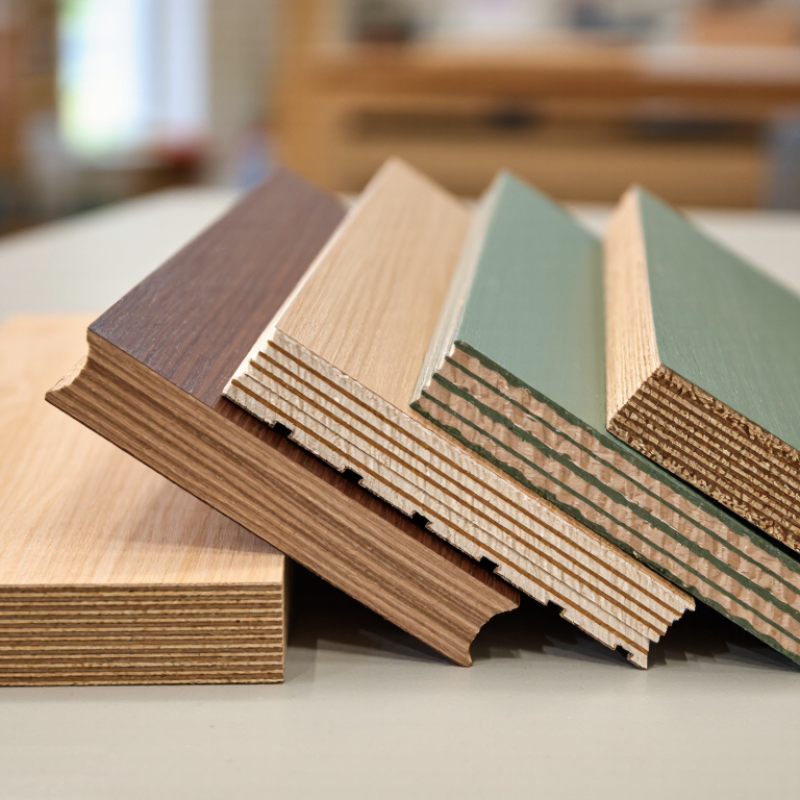
Veneer-core plywood uses stacked wood plies, usually with alternating grain directions. This construction helps resist splitting and adds stiffness, but core quality still varies. Inspect an exposed edge: large gaps or overlapping patches can signal uneven support beneath a finish. APA’s Engineered Wood Construction Guide explains how panel thickness, span rating, and installation conditions affect performance. Face grades describe appearance, not load capacity. Under PS 1, grades such as A through D indicate face quality and allowable defects. A smooth A face may suit cabinetry, while a lower face grade can work when hidden. Not interchangeable.
Structural ratings deserve a separate check. APA panel stamps may show a span rating such as 24/16. The first number refers to roof support spacing; the second refers to floor spacing, under specified conditions. That stamp is more useful than judging strength by appearance alone. Still, the rating does not remove the need to check thickness, support layout, and project loads. This part is easy to overlook.
Tips: Match the face grade to the finish you need, then verify the grade stamp for structural use. For shelving, place a sample under weight and look for sag. For floors, confirm the panel rating and installation instructions before buying. A prettier face can be the wrong board.
Compare core construction, face grades, moisture suitability, and structural-rating considerations before choosing a panel.
| Panel construction | Core and face characteristics | Face-grade considerations | Structural-rating considerations | Typical suitable uses | Key limitations |
|---|---|---|---|---|---|
| Structural veneer-core plywood | Cross-laminated wood veneers form both the core and faces. The alternating grain directions help limit movement and provide strength in both panel directions. | Structural panel grades and decorative face grades are not interchangeable. A face marked A, B, C, or D describes surface quality under the applicable grading rules. | Can be rated for structural applications when manufactured and marked to the applicable panel standard. Check the panel stamp for grade, thickness, exposure classification, and span rating. | Roof, wall, or floor sheathing when the panel’s rating and thickness match the design; also suitable for general construction. | Performance depends on the panel stamp, support spacing, loading, and installation. A decorative face grade alone does not establish structural capacity. |
| Hardwood-faced veneer-core plywood | Veneer-core construction with a hardwood face veneer selected for appearance. Face species and finish options vary by supplier and grading system. | Common descriptions include face-and-back combinations such as A/B or B/BB, but grade names and rules vary by market and product standard. Inspect the actual panel or specification. | Some products are structural; many are intended primarily for interior finish or cabinetry. Do not assume a decorative hardwood panel is rated for sheathing or load-bearing use. | Cabinetry, furniture, shelving, wall panels, and other interior work where a real-wood face is desired. | Unsealed edges and faces can absorb moisture. Select an appropriate adhesive and exposure classification for the intended environment. |
| Lumber-core plywood | A core made from narrow wood strips is faced with veneers. It is often relatively lightweight and can provide useful screw-holding in the core. | Face appearance is graded separately from the lumber-strip core; check both face quality and core construction for the intended finish. | Usually selected for furniture or interior panels rather than assumed structural use. Use only for structural applications when the product is specifically rated and marked for them. | Doors, tabletops, shelves, and furniture panels where a thicker, stable panel is useful. | Core-strip joints and construction can affect flatness and machining. Suitability for damp or exterior conditions depends on the panel’s rating and protection. |
| MDF-core laminated panel | A smooth medium-density fibreboard core is faced with decorative veneer or another facing material. It provides a uniform surface for finishing. | Appearance is generally judged by the facing material and finish quality; face-grade labels used for plywood may not apply to every MDF-core product. | Do not treat a standard MDF-core decorative panel as structural plywood. Use only a product with an explicit structural rating for load-bearing applications. | Cabinet doors, furniture components, and interior panels requiring a smooth, even face. | Standard MDF can swell if exposed to water. Edge sealing and moisture-resistant product selection may be needed in humid locations. |
| Particleboard-core laminated panel | Wood particles bonded into a core and covered with a decorative facing, such as laminate or veneer. It is commonly used in manufactured furniture and casework. | Assess the laminate or veneer for surface appearance and durability; the core is not graded like a plywood face veneer. | General-purpose particleboard-core panels are not a substitute for rated structural plywood or sheathing. Confirm the product’s stated load capacity for shelving or other supported uses. | Interior cabinetry, furniture, and built-in components in dry conditions. | Edges are vulnerable to moisture and damage, and fastener performance depends on the product and fastening method. |
Selection note: For load-bearing work, use the panel’s grade stamp and follow the applicable building code, design documents, and span tables. Exposure classifications describe intended moisture exposure during service; they do not make a panel waterproof. Face grades describe appearance or veneer quality and should not be used as a substitute for structural ratings.
Check Bond Durability Against EN 314-2’s Three Bonding Classes
The strongest choice depends on where the board will live. EN 314-2 defines three plywood bonding classes: Class 1 for dry interior conditions, Class 2 for humid conditions, and Class 3 for exterior exposure. These classes describe bond quality under specified tests; they do not rate every aspect of a panel’s strength or service life. That distinction matters.
For a dry cabinet, Class 1 may be appropriate. For a laundry room or covered, damp space, Class 2 is a more relevant benchmark. Choose Class 3 where the panel faces weather, but still protect edges and surfaces as the design requires. The USDA Forest Products Laboratory’s Wood Handbook (FPL-GTR-282, 2021) reports equilibrium moisture content near 12% at 70°F and 65% relative humidity. Moisture shifts can stress glue lines and wood layers. Look closely.
When comparing products, request the declared bonding class and test documentation, then check whether the intended use matches the test conditions. A Class 3 result is useful evidence, not a lifetime guarantee. I would also inspect cut edges and sample panels after wetting; that practical check is imperfect, but it can reveal swelling or separation that a label alone cannot.
Match Panel Thickness and Span Ratings to Loads and Support Spacing
For a 2026 project, choose plywood laminated board by checking its rated load against the distance between supports. A thicker panel may seem safer, but thickness alone does not confirm that it will resist bending or excessive deflection. A floor panel spanning widely between joists faces different demands from a shelf supported along its edges. Check the panel’s technical data for the intended use, load type, and support spacing. Ratings can vary by panel grade and installation.
Tips: Measure the actual support spacing, not the planned spacing. Check whether the rating assumes a particular panel direction or edge support. Keep the data sheet nearby during installation.
Think about what the panel will carry: evenly distributed weight, heavy equipment on small feet, or occasional foot traffic. Those loads behave differently. On site, a panel can feel firm underfoot and still flex between supports. That mismatch is easy to overlook. It is tempting to pick the thickest available board and move on, but that can add cost without solving the real issue. Compare the span rating with your measured spacing, and confirm that the proposed panel suits the exposure and fixing method. For structural floors or unusually heavy loads, ask a qualified professional to verify the design.
A laminated plywood board that looks flawless in a showroom may swell at an exposed sink edge after months of spills. For kitchens, bathrooms, or laundry rooms, check the panel’s moisture rating and edge-sealing guidance, not just its surface finish. “Water-resistant” does not mean waterproof. Cut edges and drilled holes can still absorb moisture, so inspect how the board will be sealed and installed.
Formaldehyde emissions deserve the same careful attention. Ask for current test documentation that identifies the test method and emission result; labels alone may not tell the whole story. Requirements and test systems can differ by market, so compare like with like. In a small, closed bedroom, low-emitting materials may matter more than in a well-ventilated workshop. Ventilation helps, but it is not a substitute for choosing a suitable panel.
Then estimate life-cycle cost: purchase price, installation, sealing, cleaning, and likely replacement. A cheaper board can become expensive if a damp edge needs repair within a few years. Still, predicting service life precisely is difficult; workmanship and everyday exposure matter enormously. Ask how the panel performs in conditions close to yours, and keep the answer in writing. Check the sample’s edge, too. That detail is easy to miss.