Leave Your Message
Slotted Plywood is an engineered wood panel with narrow, repeated grooves cut into its surface. These slots may run vertically, horizontally, or in carefully planned patterns. They create a practical base for shelving, display hooks, acoustic elements, and interior wall systems. The design is simple, but the details matter.
In a workshop, the grooves often feel smooth and regular under a gloved hand. Their spacing can determine whether brackets fit securely or sit awkwardly. Slotted plywood is commonly used in retail stores, offices, studios, garages, libraries, and exhibition areas. It can support adjustable storage while keeping walls visually lighter than solid cabinetry.
Still, it is not a universal solution. The panel’s strength depends on its plywood grade, thickness, slot depth, fixing method, and the weight placed on each support. A deep groove may weaken the remaining surface if the design is poorly controlled. Moisture can also cause swelling, especially around unfinished edges. That detail is easy to overlook.
Reliable installation begins with checking the manufacturer’s specifications and the wall structure. Heavy shelves may need reinforced framing, not only surface screws. Finish quality matters too. Sealed edges, consistent spacing, and accurate cutting can separate a durable installation from a disappointing one. Some applications also benefit from fire, acoustic, or formal load testing by qualified professionals.
This guide examines what slotted plywood is, how it is made, and where it performs best. It also considers practical limitations, because attractive panels can still fail when planning is rushed. The material is useful. It deserves careful judgment.
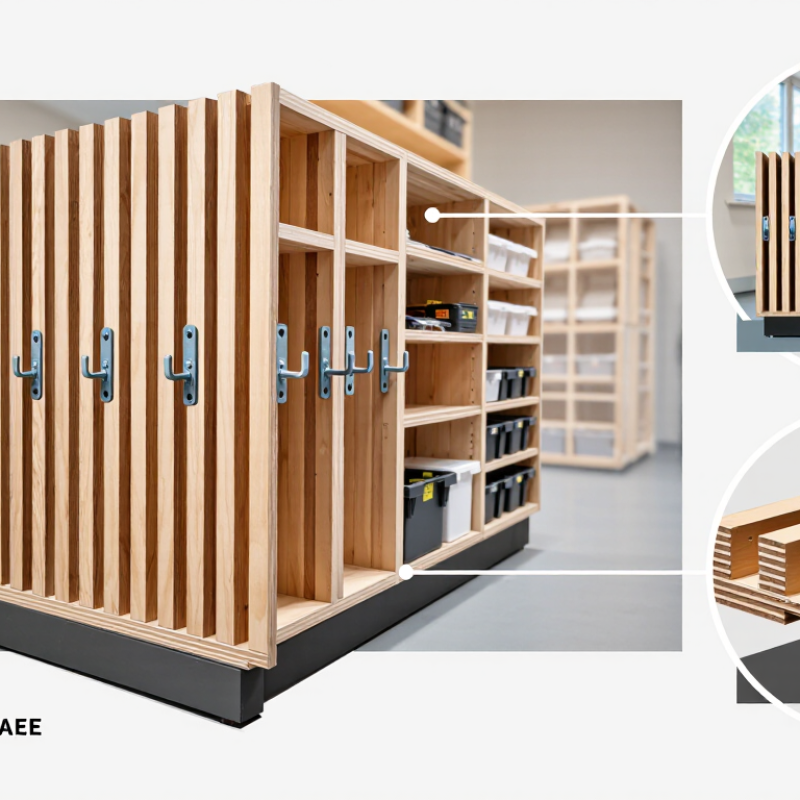
Slotted plywood is an engineered wood panel with repeated openings or grooves. These slots may pass through the face layer or remain shallow channels. The difference matters. A typical panel contains a veneer face, a layered plywood core, and a bonded rear surface. The core usually crosses grain directions. This improves stiffness and limits seasonal movement. Slot width, depth, spacing, and direction shape both appearance and performance. A 10 mm groove does not behave like a 10 mm opening. That detail is easy to miss.
In a through-slotted panel, openings cross the panel. They may support airflow, visual screening, or sound absorption with acoustic backing. In a grooved panel, the rear face remains closed. It works more like decorative wall cladding. Slots can run vertically, horizontally, or in custom patterns. CNC routing provides consistent spacing. However, edge quality still depends on tool condition and veneer quality. Measure the exposed edge. It can reveal weak bonding, splintering, or internal voids.
Installers use slotted plywood for feature walls, ceilings, room dividers, cabinet fronts, and display fixtures. Its structure must match the setting. Moisture-resistant adhesive helps, but plywood is not waterproof. Unsealed edges can swell near kitchens or humid rooms. I have seen attractive panels fail because the backing was ignored. Acoustic performance also needs testing. Slots alone do not guarantee noise control. Check thickness, fire rating, formaldehyde class, load limits, and fixing methods before installation. These details may seem like paperwork, yet they affect safety and service life.
| Data Dimension | Definition or Typical Data | Practical Significance |
|---|---|---|
| Material Definition | Slotted plywood is an engineered wood panel made from plywood with regularly spaced slots, grooves, or kerfs cut into one or both faces. | The openings give the panel functional features such as ventilation, acoustic absorption, visual texture, or support for mounting systems. |
| Basic Construction | Standard plywood consists of multiple thin wood veneers bonded together, with adjacent veneer grains generally arranged at right angles. | Cross-laminated veneers improve dimensional stability and distribute strength more evenly than a single solid-wood board. |
| Core Structure | The core may be composed of veneer layers, a lumber-core construction, or a composite wood core, depending on the panel specification. | The core influences bending strength, screw-holding performance, weight, and resistance to warping. |
| Slot Orientation | Slots are commonly arranged parallel, in repeated linear patterns, or in custom geometric layouts. | Pattern direction affects appearance, sound absorption behavior, airflow, and the panel’s visual emphasis. |
| Slot Depth | Slots can be shallow surface grooves or deeper routed openings that extend substantially into the face layer without necessarily passing through the panel. | Deeper slots generally create stronger visual relief and can expose more surface area for acoustic or decorative purposes. |
| Perforation Type | Depending on the design, the slots may be blind grooves, open slots, or perforations backed by an acoustic fabric or absorber. | The opening type determines whether the panel primarily serves decorative, acoustic, ventilation, or access functions. |
| Common Thicknesses | Commercial plywood panels are commonly produced in thicknesses from approximately 6 mm to 25 mm, although available sizes vary by region and specification. | Thicker panels generally provide greater rigidity and screw-holding capacity, while thinner panels reduce weight. |
| Common Panel Sizes | Typical sheet formats include approximately 1,220 × 2,440 mm and 1,220 × 2,500 mm; larger or custom formats may also be available. | Sheet dimensions affect layout efficiency, joint placement, transportation, and installation time. |
| Surface Materials | The visible face may use hardwood veneer, softwood veneer, decorative laminate, paint-grade plywood, or a clear-coated wood surface. | The face material determines the panel’s appearance, cleanability, wear resistance, and finishing requirements. |
| Edge Treatment | Edges may remain square, receive a solid-wood strip, be banded with veneer, or be concealed by a frame or adjacent panel. | Edge treatment improves visual continuity and can protect the plywood layers from impact and moisture exposure. |
| Acoustic Use | Slotted plywood can be combined with an air cavity, mineral-fiber absorber, polyester backing, or acoustic fabric to help control reflected sound. | Acoustic performance depends on slot width, spacing, open area, backing material, cavity depth, and installation method. |
| Ventilation Function | Open-slot panels allow limited air movement when installed with a suitable clear cavity or ventilation path. | They may be used for architectural screens, radiator covers, cabinet fronts, and other applications requiring airflow and visual screening. |
| Typical Interior Applications | Common uses include wall cladding, ceiling panels, room dividers, reception features, cabinet doors, display panels, and decorative screens. | The material combines the appearance of natural wood with a repeatable, engineered pattern. |
| Furniture Applications | It may be used for cabinet fronts, shelving backs, desk screens, headboards, and lightweight furniture components when the design is properly supported. | Designers can use the slots to reduce visual mass, add ventilation, or create a distinctive surface pattern. |
| Structural Limitations | Routing or cutting slots removes material and can reduce local strength, stiffness, impact resistance, and screw-holding capacity. | Slotted panels should not automatically be treated as equivalent to unmodified structural plywood; load-bearing use requires engineering review. |
| Moisture Considerations | Interior-grade panels are intended for dry conditions, while exterior or moisture-resistant plywood uses appropriate adhesive and face specifications for more demanding exposure. | Slots and exposed edges can provide additional paths for moisture entry, so sealing and suitable installation are important in humid areas. |
| Fire Performance | Standard wood plywood is combustible. Fire-rated performance is not inherent and must be confirmed through the complete tested panel and assembly specification. | Projects in public, commercial, or regulated spaces may require documented fire classifications and approved installation details. |
| Installation Methods | Panels may be fixed to battens, furring channels, framing, clips, or a solid substrate using screws, concealed fasteners, or compatible adhesives. | A stable substructure helps maintain alignment, provides a cavity when needed, and reduces the risk of panel movement. |
| Finishing Options | Common finishes include clear varnish, water-based coating, oil, stain, paint, or factory-applied decorative laminates. | Finishing protects the surface, changes color and sheen, and can make routine cleaning easier. |
| Key Selection Factors | Important factors include plywood grade, veneer quality, panel thickness, slot geometry, open area, moisture exposure, fire requirements, acoustic goals, and installation support. | Matching the panel specification to the intended environment helps prevent warping, cracking, poor acoustics, and premature surface damage. |